April 15, 2026
Eliminating Foam in Bioreactors
In this article, we’ll discuss why foam forms, why conventional anti‑foam strategies are insufficient, and how BioThrust’s ComfyCell uses a foam‑free, bubble‑free aeration concept to remove the root cause of foaming rather than just treating its symptoms.

.png)

Executive Summary
Foam is a persistent limitation in high-density mammalian cell culture, where conventional bubble sparging can create shear stress, sensor interference, contamination risk, and dependence on antifoam additives. BioThrust’s ComfyCell bioreactors address the problem at its source with membrane-based, bubble-free aeration, enabling efficient gas transfer without foam while maintaining gentle conditions for sensitive CHO, stem, and immune cells.
Foam is one of the most persistent headaches in bioreactor operation, especially when you work with high‑density cultures (of stem cells, immune cells, CHO cell, ...) that eventually require sparging to meet their oxygen demand. In this article, we’ll walk through why foam forms, why conventional anti‑foam strategies are increasingly problematic, and how BioThrust’s ComfyCell bioreactors use a foam‑free, bubble‑free aeration concept to remove the root cause of foaming rather than just treating its symptoms.
Why foam is such a problem in cell culture
In mamalian cell culture, cells lack a protective wall and are much more sensitive to shear stress and to the physical environment at the gas–liquid interface than microbial systems. As titers and viable cell densities increase, oxygen demand increases, driving higher sparging and agitation rates in stirred‑tank bioreactors (STRs) and, inevitably, more foam.
Foam in mammalian cell cultures in bioreactors causes several intertwined problems:
- Reduced oxygen transfer and mass transfer
Foam traps bubbles at the liquid surface, reducing the effective interfacial area for gas exchange. This can compromise dissolved oxygen (DO) control and lead to local hypoxia in dense CHO or immune cell cultures.
- Sensor fouling and false readings
Foam easily coats DO, pH and even temperature probes, leading to noisy or biased measurements and incorrect controller responses (e.g., overshooting gas or base addition).
- Cell damage and cell loss
Foam lamellae can entrap suspended mammalian cells and pull them into high‑stress regions near the surface where films rupture, causing mechanical stress and even complete loss of cells in the foam layer.
- Contamination and operational risk
Excess foam can reach gas filters, exhaust lines, or sampling ports, raising contamination risk and forcing emergency antifoam additions or manual interventions.
For robust microbial fermentations the above may be tolerable to a degree; for sensitive iPSC‑derived cells, NKs, CAR‑Ts, or delicate CHO subclones producing complex biologics, it represents a serious risk for product quality and overall process robustness!
What actually causes foaming in STR bioreactors?
Foam is ultimately a physical manifestation of surface‑active components stabilizing gas–liquid interfaces in the presence of bubble formation and agitation. In typical STR cultures of CHO or stem cells, several drivers come together:
- Surface‑active media components and secreted proteins
Serum, hydrolysates, poloxamers, and recombinant proteins lower surface tension and stabilize bubbles. Over the course of a fed‑batch or perfusion run, secreted monoclonal antibodies, viral vectors, or host cell proteins further increase foam stability.
- Sparged gas and high gas flow rates
Conventional STRs rely on bubble sparging (e.g., through ring or microspargers) to meet oxygen transfer requirements. Each bubble formed and broken at the surface contributes to foam formation, particularly at higher aeration rates used for intensified CHO and immune cell processes.
- Agitation and shear
Higher impeller speed increases gas dispersion and bubble break‑up; this improves oxygen transfer but also creates many small, stable bubbles that are strongly stabilized by proteins and surfactants.
- Process intensification
The industry‑wide drive to higher viable cell densities, particularly in CHO perfusion and new cell therapy applications, has pushed both oxygen transfer and carbon dioxide stripping toward the limits of STR designs. This makes foaming not just a nuisance, but a direct bottleneck for further intensification.
The key point: as long as we rely on conventional bubble sparging in bioreactors, foam is a structural side effect of how we deliver oxygen and strip CO₂.
Conventional strategies to control foam
Most existing solutions focus on treating the foam after it forms, or slightly reducing its formation by tuning operating conditions. Below are 3 widely used approaches, with their pros and cons for CHO, stem cells and cell therapy cultures.
1. Chemical antifoam addition
The primary industry method for foam control in bioreactors is the addition of liquid antifoam agents, typically silicone‑based or organic polymer formulations. These reduce surface tension and destabilize foam films, causing bubbles to coalesce and collapse.
Advantages:
- Rapid and effective foam collapse when dosed correctly
- Easy to implement with a foam probe and peristaltic pump
- Compatible with existing STR hardware
Limitations for sensitive and therapeutic cultures:
- Antifoam is a process contaminant that can be challenging to fully remove downstream, increasing burden on clarification and filtration steps.
- Some antifoams can adsorb proteins or interact with host cell proteins, impacting product recovery and potentially product quality.
- Excessive antifoam can be cytotoxic or impair mass transfer by blocking bubble surfaces, paradoxically decreasing kLa.
- Regulatory expectations for chemically defined processes in stem cell and cell therapy manufacturing push toward minimizing extraneous additives.
For stem cells,engineered immune cells that are already sensitive to media composition and impurities, reliance on heavy antifoam use is increasingly hard to justify.
2. Process parameter tuning: gas flow and sparging strategy
Foam can be mitigated by reducing gas flow rates, altering sparger design, or shifting more gas addition to the headspace. For example, CHO cell guidelines often recommend limiting sparged aeration to low vvm values (e.g., ≤0.15 vvm) and supplementing oxygen via enriched gas or headspace gassing.
Advantages:
- Reduces foam formation at the source by generating fewer bubbles.
- Avoids adding new chemical components to the medium.
- Often simple to implement in modern single‑use STRs with flexible gas mixing strategies.
Limitations:
- Reduced bubble formation also reduces oxygen transfer; at high cell density this can push the system into oxygen limitation.
- Lower gas flow can impair CO₂ stripping, leading to pCO₂ build‑up with negative effects on growth, productivity and glycosylation.
- Changing sparger designs or gas flow patterns is a partial fix; bubbles and gas–liquid interfaces are still present.
In other words, we trade foam against oxygen transfer and CO₂ control, which is not an attractive long‑term solution for intensified processes that should be repeatable.
3. Mechanical and optical foam detection and control
Many production bioreactors use foam probes (conductivity or capacitance‑based) to trigger antifoam addition only when needed. Recently, optical systems have been developed to monitor foam height and dynamics in real time, improving process understanding and enabling more nuanced control algorithms.
Advantages:
- Minimizes antifoam consumption by dosing only when foam exceeds a threshold.
- Provides process analytical technology (PAT) data on foaming tendencies, media formulations, and feeding strategies.
- Retrofittable in many existing STR systems.
Limitations:
- Still reactive: foam must form before it can be detected and countered.
- Complex foam behavior can lead to oscillatory control (frequent on/off dosing).
- Does not address the underlying cause: bubble‑based aeration in a surfactant‑rich environment.
For state‑of‑the‑art CHO and stem cell processes, this combination of antifoam, conservative gas flows, and smarter sensing has stretched STR technology quite far, but it also reveals the fundamental limitation: as long as we create bubbles, we will fight foam.
Foam‑free thinking: bubble‑free aeration concepts
To truly remove foam from the equation, we need to re‑think how oxygen enters and CO₂ leaves the culture. Bubble‑free, membrane‑based aeration concepts have therefore attracted increasing attention as a way to decouple gas transfer from bubble formation.
In dynamic membrane aeration systems or membrane stirrers, oxygen is delivered through gas‑permeable surfaces integrated into the mixing device, allowing high oxygen transfer rates without discrete bubbles and therefore without foam. A recent membrane‑stirrer system demonstrated high OTR values while maintaining completely foam‑free cultivations, even for biosurfactant‑producing strains that typically foam aggressively.
This principle of intense mixing plus distributed membrane area for gas transfer, but no bubble sparging forms the conceptual basis for the BioThrust ComfyCell foam‑free bioreactor platform.
The BioThrust ComfyCell foam‑free bioreactor concept
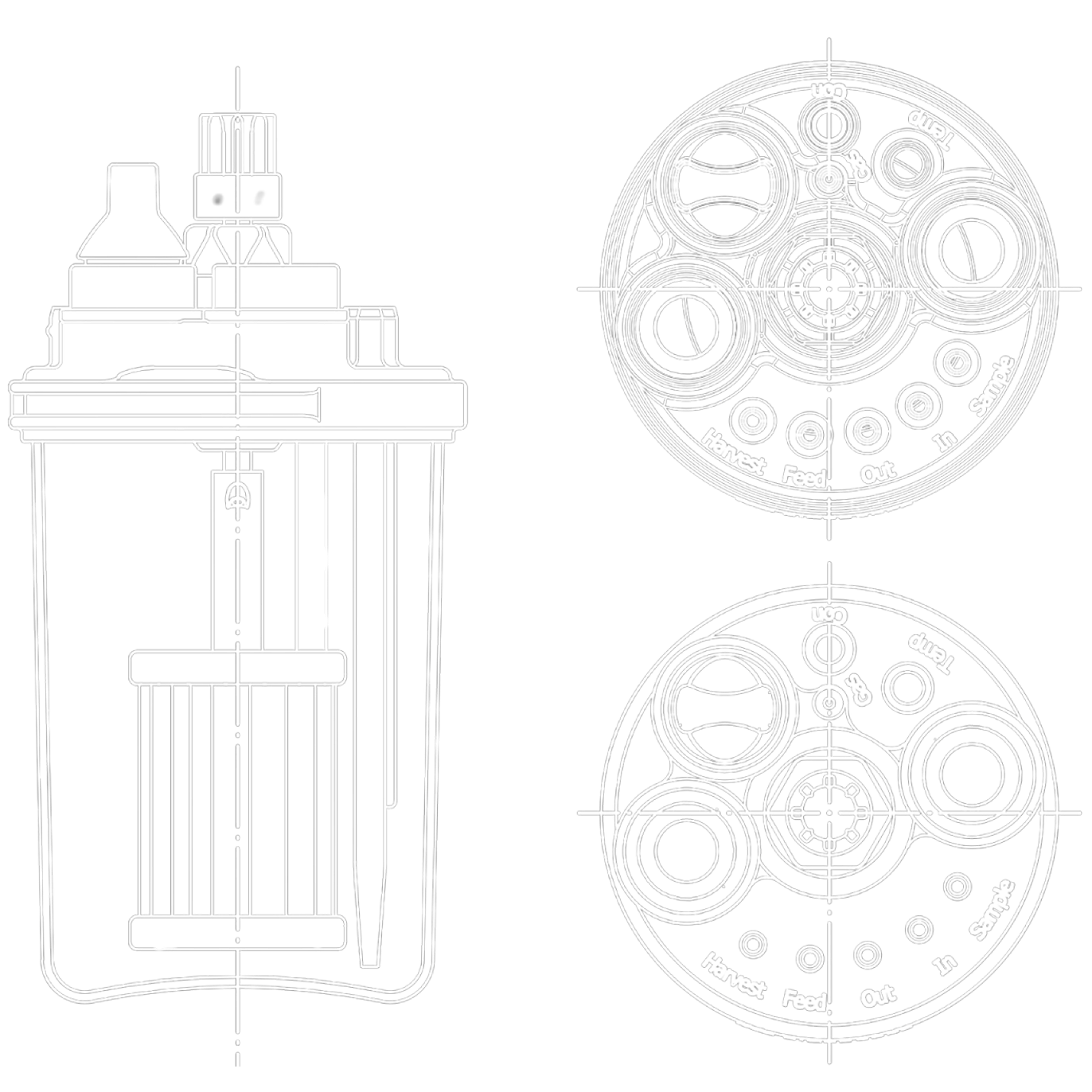
The BioThrust ComfyCell bioreactor is a stirred‑tank system redesigned around a membrane‑based, bubble‑free aeration and gas management architecture. Although it retains STR‑like process handling (impeller, standard probes, single‑use compatibility), its core gas transfer mechanism is fundamentally different from ring or microspargers.
At the heart of the system is an integrated membrane module that also acts as the mixing device (impeller), enabling:
- Bubble‑free oxygen transfer directly into the liquid, via gas‑permeable membranes exposed to the culture without releasing discrete bubbles.
- Efficient CO₂ removal along similar pathways, thanks to high interfacial area and controlled gas‑side composition.
- Homogeneous mixing so that oxygen-rich regions are rapidly distributed without local gradients or micro‑bubbles.
Since there is no conventional sparging, the culture contains no sparged bubbles and the classical foam dome at the surface simply does not develop, even under high oxygen load. This “foam‑free by design” approach addresses the root cause of foaming—gas bubbles in a surfactant‑rich liquid—rather than compensating downstream via antifoam or process constraints.
Case Study: Foam‑free NK‑92 culture in ComfyCell bioreactors
In a recent peer‑reviewed study in Frontiers in Bioengineering and Biotechnology, a BioThrust‑derived foam‑free membrane‑stirrer bioreactor was used to cultivate NK‑92 cells, an immune cell line highly relevant for allogeneic cell therapy applications and known to be shear‑sensitive. Despite high oxygen demand and the presence of surface‑active components in the medium, the cultivation proceeded without visible foam formation throughout the process.
Key observations from that work include:
- Foam‑free operation at process‑relevant viable cell densities
NK‑92 cells were expanded in suspension without the formation of a stable foam layer, in contrast to what is often observed in conventional STRs under comparable gas‑demand conditions.
- Sufficient oxygen transfer without sparging
The membrane‑based stirrer provided adequate oxygen transfer rates to support high viable cell densities and growth rates, while still maintaining a foam‑free surface.
- Gentle hydrodynamics for shear‑sensitive cells
The absence of large gas–liquid interfaces and bursting bubbles reduced shear hotspots at the surface, which is particularly beneficial for NK‑92 and other cell therapy‑relevant lines.
This study demonstrates that foam‑free culture is not just a theoretical ideal; it is achievable for real, clinically relevant immune cells at scales and conditions that matter for bioprocess development.
Why foam‑free culture matters for CHO and stem cells
While NK‑92 provides a compelling proof‑of‑concept, the same design philosophy is directly applicable to CHO, iPSC‑derived cells, and other sensitive mammalian systems. Foam‑free operation delivers several concrete advantages for these platforms.
1. Complete elimination of antifoam
Because the ComfyCell design inherently avoids bubble sparging, foam does not form in the first place, and the need for classical silicone‑based antifoams is drastically reduced or completely eliminated. This directly benefits:
- Downstream processing, by avoiding antifoam‑related fouling or product losses on depth filters and chromatography resins.
- Regulatory acceptance, by simplifying the media and feed composition for therapeutic products.
- Process robustness, by removing a common source of variability and troubleshooting (over‑ or under‑dosing antifoam).
2. Gentler environment for shear‑sensitive cells
Stem cells, certain CHO clones, and many immune effector cells are especially sensitive to hydrodynamic stress and gas–liquid interface damage. Without bubbles and foam lamellae, the ComfyCell hydrodynamic environment is defined primarily by liquid mixing, which can be tuned independently of gas transfer demands. This helps maintain cell viability and phenotype in:
- iPSC expansion and differentiation processes
- NK‑92 and CAR‑NK production
- Advanced CHO cell lines in intensified fed‑batch or perfusion modes
The NK‑92 work shows that clinically relevant immune cells can thrive under these conditions, providing confidence for extending the concept to other demanding lines.
3. Stable sensors and straightforward PAT
In foam‑free operation, DO and pH sensors are no longer buried under a fluctuating foam layer or coated with antifoam films. This improves:
- Signal quality and control stability for DO and pH loops.
- Integration of optical or imaging‑based PAT tools, which benefit from a clear liquid surface rather than a white foam dome.
For CHO and stem cell processes increasingly relying on real‑time analytics and model‑based control, this “clean” environment is an important enabler.
4. More freedom for process intensification
By decoupling gas transfer from foam formation, ComfyCell bioreactors open up new design space for:
- Higher viable cell densities and longer culture durations, without hitting foam‑related operational limits.
- Aggressive feeding strategies or surfactant formulations (e.g., novel surfactants like Peptonics) that would otherwise increase foaming risk in STRs.
- Perfusion and high‑intensity fed‑batch regimes for CHO and therapeutic cells where oxygen demand and secretion levels are both high.
Instead of negotiating a trade‑off between oxygen transfer, CO₂ stripping and foam, you can focus on what the cells actually need to grow and produce optimally.
How ComfyCell fits into existing STR‑based workflows
A natural concern when introducing any new bioreactor concept is compatibility with existing infrastructure, process development experience, and regulatory expectations. The ComfyCell bioreactor was conceived to feel familiar to STR users while removing the specific pain point of foam:
- STR‑like geometry and mixing
Vessel shapes, working volumes and impeller‑driven mixing are conceptually similar to single‑use STRs, easing scale‑up and tech transfer.
- Standard instrumentation and control
Conventional DO, pH, temperature and level measurement are used; control strategies remain recognizable to process engineers trained on STR platforms.
- New gas path, same upstream workflows
Media, inoculation, sampling, and harvesting procedures stay essentially the same. The main difference is how oxygen and CO₂ are handled—via the membrane‑stirrer module instead of spargers.
From a risk‑management perspective, this hybrid of proven STR handling with novel foam‑free aeration is attractive: it allows teams to de‑risk foam and antifoam‑related issues while leveraging existing know‑how and documentation.
When should you consider foam‑free bioreactors?
If your search history includes “bioreactor antifoam CHO,” “remove foam stem cells,” or “STR foam sensor always triggered,” you are likely already facing some of the following symptoms:
- Frequent antifoam additions, with unclear impact on downstream yield and filter fouling
- Sensor drift and noisy DO/pH signals during high‑density phases
- Unexplained drops in viability or phenotype changes associated with late‑stage foaming
- Hard limits on cell density in perfusion or intensified fed‑batch processes due to oxygen and foam constraints
In such cases, a foam‑free bioreactor like BioThrust’s ComfyCell can be more than just a convenience upgrade; it can become a strategic lever to unlock the next level of process performance and robustness for CHO, stem cells, and cell therapies.
Have questions or need finding the right solution?
Our team is here to help you achieve your research goals.

Related Articles
.png)