


April 8, 2026
Eliminating cell therapy manufacturing bottlenecks [1]
BioThrust’s ComfyCell bioreactors combine low shear forces with efficient bubble-free gas transfer to support high-density 3D stem cell cultures and improve scalability, cell quality, and COGS.


Executive Summary
BioThrust’s ComfyCell bioreactors address a key challenge in 3D cell therapy manufacturing: achieving high gas transfer without exposing sensitive cells to damaging shear forces. By combining ultra efficient bubble-free membrane aeration with gentle mixing, ComfyCell supports high-density iPSC and stem cell cultures while improving process scalability, consistency, and ultimately cost efficiency.
Insufficient oxygen transfer is one of the quiet killers of 3D bioreactor culture for iPSC‑derived and other allogeneic stem cell therapies, driving up process scale, complexity and ultimately COGS per dose. BioThrust’s ComfyCell bioreactors are designed to break this trade‑off by combining low shear with very high gas transfer, so you can reach commercially relevant cell numbers without sacrificing cell quality.
The gas transfer bottleneck in 3D stem cell culture
Oxygen and carbon dioxide are the two gases that most strongly limit viable cell density and function in 3D cultures. In aggregates, spheroids, or dense suspension cultures, oxygen must diffuse from the medium into a 3D structure, and beyond a critical size cells in the core face hypoxia or even anoxia.
For iPS(‑derived) cells, mesenchymal stromal cells or immune cells, this leads to:
- Heterogeneous populations with hypoxic cores and stressed phenotypes.
- Loss of viability and functional potency in the center of large spheroids.
- Strong coupling between operating conditions (agitation, gas supply) and final product quality.
From a process‑design perspective, poor gas transfer means bigger reactors, more culture time, and more media per dose, all of which push COGS in the wrong direction.
How gas transfer limitations drive high COGS
Allogeneic cell therapy aims to deliver “off‑the‑shelf” doses with 10⁸–10¹⁰ cells or more per patient, at clinical and commercial scale. However, current 3D culture technologies often struggle to reach the cell numbers per mL needed to make those doses economical.
Consequences include:
- Oversized processes
To hit the same dose numbers, you must run more bioreactors, larger volumes or more batches if volumetric productivity is capped by oxygen transfer rather than cell biology.
- Longer culture durations
When agitation or gas flow are limited by shear sensitivity, cell expansion slows and more days in culture are needed to reach target yields, inflating labor and facility costs.
- Complex, labor‑intensive workflows
Many CGT processes still rely on stacked flasks, bags or small bioreactors because true high‑density operation is not feasible for sensitive cells; this undermines economies of scale.
Allogeneic cell therapy bioprocess economics analyses consistently flag expansion technologies and gas transfer as central constraints on achieving commercially viable COGS.
Why gas transfer is so hard in conventional systems
1. 3D aggregates and diffusion limits
In 3D aggregates and spheroids, oxygen and nutrients must diffuse over distances of hundreds of micrometers. Fick’s law tells us that diffusion flux decreases with distance, so beyond roughly 100–200 µm, central regions of the spheroid become oxygen‑poor, leading to necrotic cores and metabolic heterogeneity.
For iPSC‑derived tissues, pancreatic islets, neural organoids and similar models, this makes it very difficult to scale up size without losing central viability or function.
2. Stirred‑tank bioreactors with bubble sparging
Traditional stirred‑tank bioreactors (STRs) address gas transfer by:
- Increasing agitation to improve mass transfer
- Sparging air/oxygen to raise kLa and support higher cell densities
But for pluripotent stem cells and many allogeneic products, these levers are constrained: sparging causes cells to attach to bubbles and experience high shear at the gas–liquid interface, while high impeller speeds increase hydrodynamic stress. As a result, processes are often run conservatively, below their theoretical gas transfer capacity, to protect cell viability and phenotype.
3. Low‑shear 3D devices with limited gas exchange
On the other end of the spectrum, many “gentle” 3D culture systems—such as static 3D scaffolds, rotating wall vessels or slow‑moving horizontal bioreactors—prioritize low shear but struggle with gas and nutrient transport. Thin layers of medium or low‑speed mixing can protect stem cells, but often at the cost of high volumetric productivity and precise gas control.
The core challenge is this: CGT workflows need both low shear and high gas transfer, but most conventional systems force you to choose one or the other.
BioThrust ComfyCell: low shear and high gas transfer by design
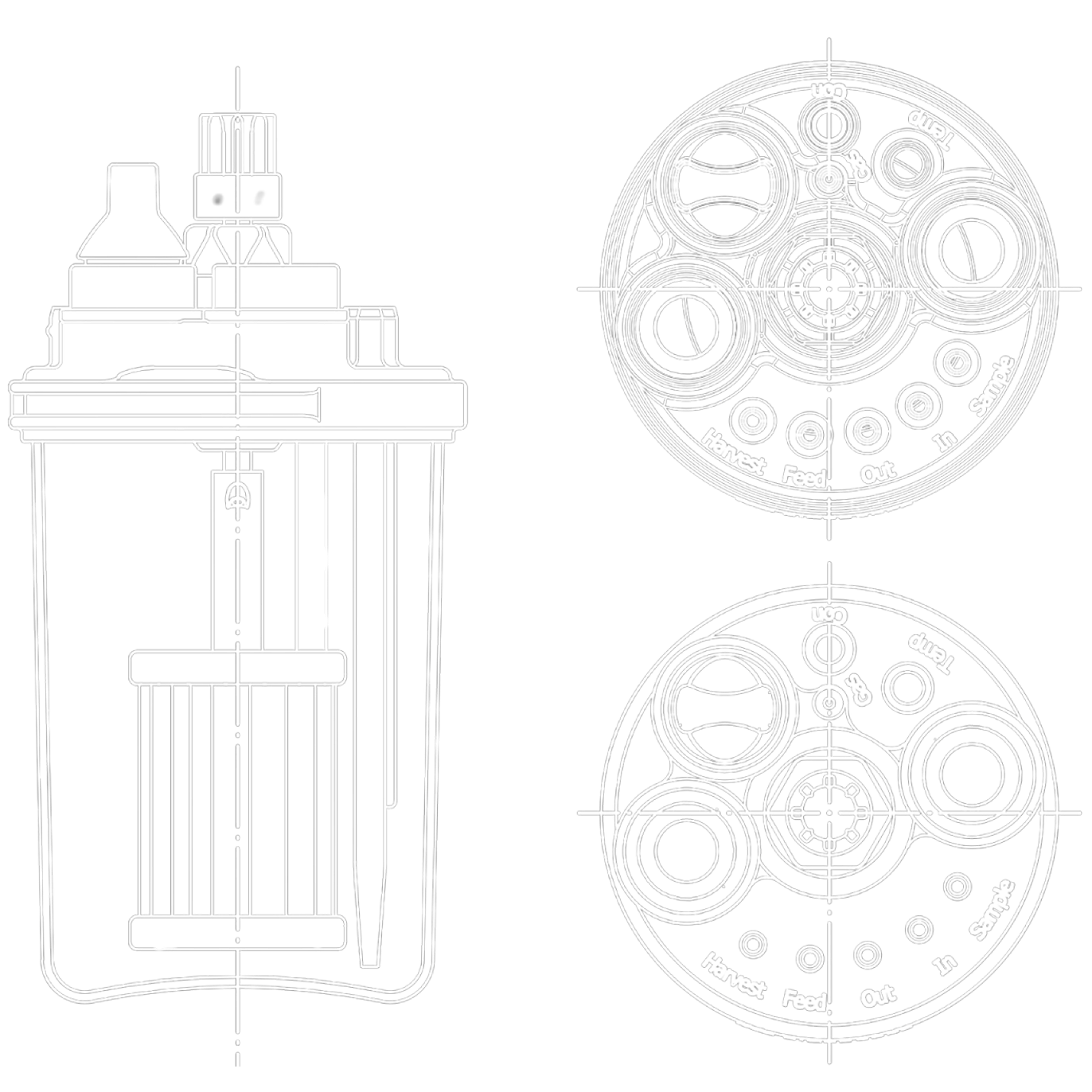
BioThrust’s ComfyCell bioreactors were designed specifically to decouple gas transfer from mechanical stress using a membrane‑based, bubble‑free architecture. Instead of sparging gas into the culture, ComfyCell integrates a gas‑permeable membrane with the mixing system, enabling high oxygen transfer without exposing cells to bursting bubbles.
Membrane‑based, bubble‑free aeration
In the ComfyCell concept, oxygen and other gases are supplied via a controlled gas phase that diffuses across a membrane surface directly into the culture, without forming discrete bubbles. This architecture:
- Provides a large, distributed gas–liquid interfacial area inside the bioreactor.
- Maintains high volumetric oxygen transfer (kLa) without foam or bubble‑induced shear.
- Supports efficient CO₂ removal and tight pH control, critical for sensitive iPSC cultures.
By eliminating sparging, ComfyCell avoids the classic trade‑off between higher gas flow and increased shear/foam.
Low‑shear flow fields
Because gas transfer no longer relies on aggressive sparging, agitation can be tuned primarily for homogeneous mixing and aggregate suspension—not to chase oxygen transfer. CFD‑informed fluid dynamics and gentle circulation patterns keep shear stress in a range suitable for pluripotent stem cells, mesenchymal stromal cells and other sensitive CGT substrates.
In practice, BioThrust has demonstrated hiPSC perfusion with cell densities exceeding 40 million cells/mL while maintaining high viability and pluripotency markers, underscoring the combination of high gas transfer and cell‑friendly hydrodynamics.
Advantages over conventional 3D CGT approaches
Below we compare ComfyCell’s design and impact with three common 3D culture approaches used in CGT.
A) VS Static 3D scaffolds and gas‑permeable plates
Static PDMS or gas‑permeable culture platforms improve oxygenation near the culture surface and can reduce anoxia in small spheroids. They are attractive for early research but suffer from limited scalability and process control.
ComfyCell vs static 3D:
- ComfyCell maintains low shear but adds true bioreactor‑grade control of DO, pH, temperature and feeding, supporting industrial volumetric productivities.
- Instead of widening plates or stacking devices, you scale up volume within a single controlled system, directly improving COGS through economies of scale.
B) VS Stirred‑tank aggregates with conventional sparging
Many iPSC and MSC expansion processes have moved into STRs with microcarrier‑free aggregate cultures. These enable higher densities than static systems, but gas transfer is limited by the need to protect cells from sparging‑induced shear and foam.
ComfyCell vs conventional STR:
- ComfyCell offers high oxygen transfer without bubbles, allowing higher viable cell densities at equal or lower shear compared to STRs.
- Foam is inherently avoided rather than managed with antifoam, which simplifies downstream processing and reduces risk of product loss on filters or resins.
- Because gas transfer does not depend on increasing impeller speed or sparge rate, process windows for allogeneic products can be designed around cell biology instead of equipment constraints, supporting more robust COGS models.
C) VS Low‑shear horizontal or rotating bioreactors
Horizontal or rotating wall systems offer low shear for sensitive cells, and some designs incorporate improved gas exchange via thin films or specialized geometries. However, they often lack the tight process control and scalability of more standard bioreactors.
ComfyCell vs low‑shear specialty devices:
- ComfyCell combines comparable low‑shear conditions with full bioreactor instrumentation and automation, simplifying integration into GMP facilities.
- Its membrane‑based gas transfer is inherently scalable; increasing membrane area and volume follows standard bioreactor scaling principles, easing the path from development to commercial production.
Across these comparisons, the key differentiator is that ComfyCell tackles gas transfer at the architectural level, not as an afterthought, enabling high‑density, low‑shear 3D culture that directly improves per‑dose economics.
Our key takeaways for CGT developers and CDMOs
- Gas transfer limits are a major hidden driver of high COGS in allogeneic cell therapy.
- Most conventional 3D systems force a trade‑off between low shear and high oxygen transfer; ComfyCell’s membrane‑based design is built to deliver both.
- Moving iPSC and other CGT workflows into foam‑free, high‑density ComfyCell processes can unlock higher doses per batch, more robust product quality, and a clearer path to commercial viability.
Have questions or need finding the right solution?
Our team is here to help you achieve your research goals.

Related Articles
.png)

.png)
