


August 19, 2026
Scaling high density iPSC perfusion cultures
Learn how our iPSC expert Marco reached 11 million iPSC per mL in a 5 day perfusion process with the ComfyCell Benchtop 2L bioreactor.

.png)

Executive Summary
Perfusion is neccessary for high density iPSC expansion, yet the choice of perfusion system heavily depends on process goals. BioThrust has developed a novel in-situ perfusion system integrated into the bioreactor consumable. Together with bubble-free diffusive membrane aeration, a new level of process efficiency for iPSC production can be reached - up to 11 million cells/mL at 2L scale in 5 days!
High-Density iPSC Culture: Oxygen Transfer and Perfusion as the Main Scale-Up Barriers - but not with the ComfyCell bioreactor
Commercial iPSC manufacturing requires high viable-cell density, reliable pluripotency, controlled spheroid growth, and a process that remains practical as culture volume increases. At higher density, oxygen demand, nutrient consumption, and metabolite formation rise exponentially. This makes gas transfer and media exchange central process challenges. BioThrust is developing the ComfyCell bioreactor platform to address both areas through membrane-based oxygen transfer (Membrane Stirrer) and integrated in-situ perfusion.
Why conventional bioreactors reach a limit
Stirred-tank reactors, vertical-wheel bioreactors, and other conventional systems can support iPSC spheroid culture. But, at increasing cell density, their oxygen-transfer capacity becomes limiting when the process depends mainly on headspace or surface aeration. The realistic upper limit for these systems is 2-3 million cells per mL at volumes above a litre, even if technical simulations are skewed to suggest otherwise.
Higher agitation can improve mixing and oxygen transfer, but it can also affect spheroid morphology and expose cells to stronger hydrodynamic conditions. Direct sparging provides additional oxygen-transfer capacity, yet it is pretty much unsuitable for iPSC spheroids. Bubbles can create local shear, foam, and stress at the gas-liquid interface, which can affect aggregate stability and cell performance. Oxygen transfer has been identified as a key determinant of the maximum achievable cell density in iPSC aggregate culture.
Membrane-based oxygen transfer as employed in the ComfyCell bioreactor provides a practical alternative, provided the membrane is capable enough. Oxygen is supplied across a gas-permeable PMP membrane, allowing a high oxygen-transfer capacity without direct sparging into the cell suspension. Earlier concepts in the 90s and 2000s used silicone membranes, much too thick and this not able to supply enough oxygen. BioThrust has solved this problem.
Perfusion solves media exchange, but retention matters
At high density, iPSC cultures require frequent media exchange to replenish nutrients, support pH control, and remove lactate and other metabolic by-products. Perfusion can provide this continuously or semi-continuously. The main technical question is how to retain iPSC spheroids while removing spent medium. Simple dip-tube or screen-based retention systems are attractive because they are compact and inexpensive. Unfortunately, their available retention area is limited. As cell density and aggregate size increase, spheroids, cellular debris, and extracellular material can accumulate at the retention interface. This can reduce flow, increase process variability, and eventually lead to clogging.
ATF and TFF systems provide larger filtration areas and are widely used for perfusion culture. They can reduce fouling relative to direct filtration, but they add external equipment, tubing, pumps, sterile connections, and process complexity. They also circulate cells and spheroids through an external loop. For shear-sensitive iPSC aggregates, mechanical stress from pumping, pressure changes, and recirculation must be carefully controlled. Especially smaller bioreactor volumes are difficult to couple with external perfusion as too much media is removed from the vessel, relative to total working volume, leading to temperature control issues.
ComfyCell: membrane oxygen transfer plus in-situ perfusion
The ComfyCell system uses BioThrust’s MemStir technology to provide bubble-free oxygen transfer within the culture vessel. Our bioreactor supports aggregate culture and provides higher oxygen-transfer capacity without direct sparging. Thus, with oxygen transfer addressed, reliable perfusion becomes the next priority. BioThrust’s in-situ perfusion system is integrated into the ComfyCell consumable, as a cell rention grid across the entire bioreactor bottom. The design provides a larger retention surface area than a conventional dip-tube approach. This reduces local loading at the retention interface and supports higher media-exchange capacity as the iPSC culture grows. At 300mL, we facilitated up to 7 full volume changes per day for high density iPSC culture - up to 44 million iPSC per mL.
The system is intended to provide:
- Bubble-free oxygen transfer through the MemStir
- Gentle mixing for iPSC spheroids
- Integrated cell retention and media exchange
- Reduced reliance on external ATF or TFF loops
- Fewer tubing connections and external components
- A scalable route toward intensified iPSC culture
First 2 L proof of concept
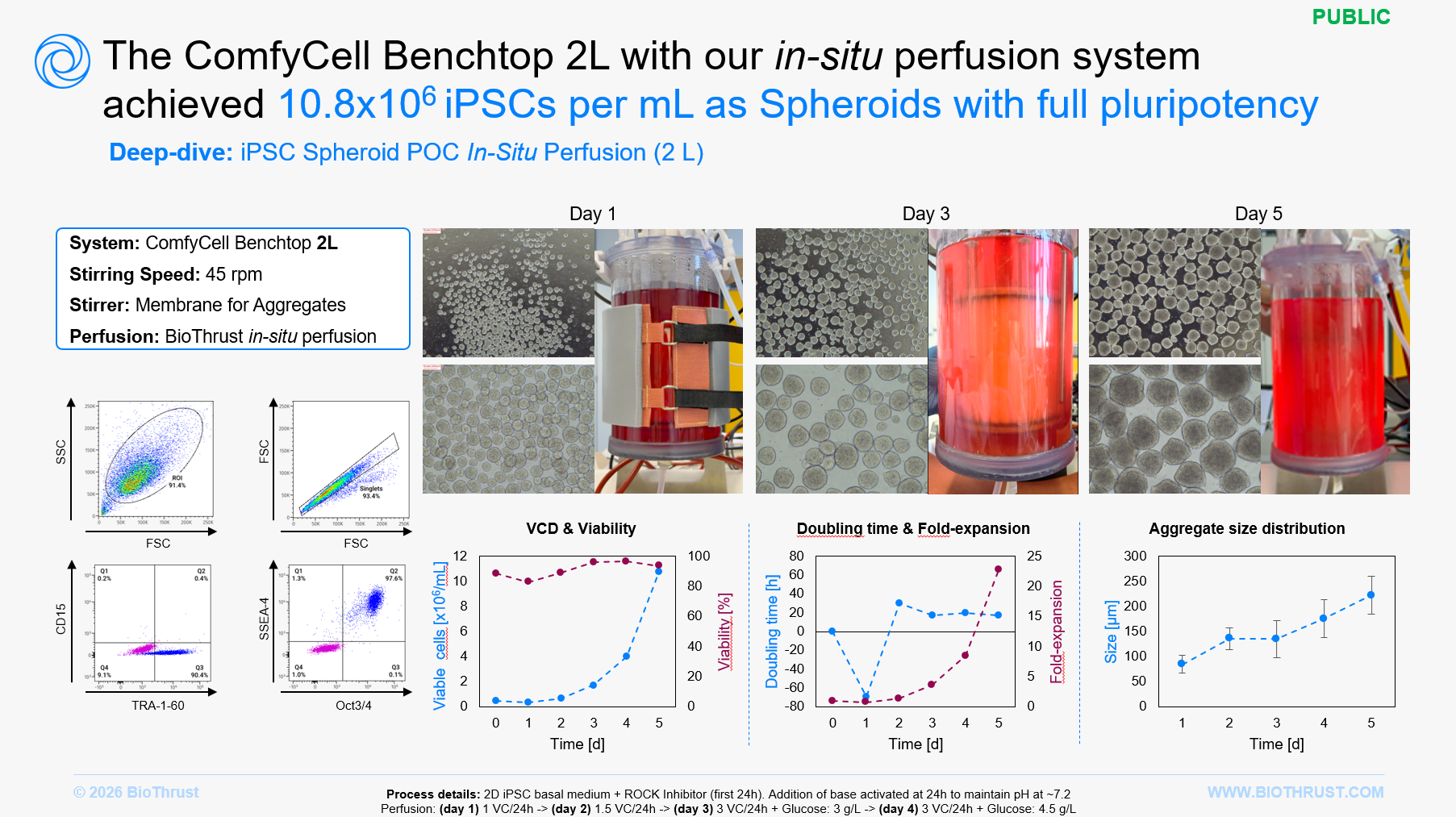
In the first ComfyCell Benchtop 2 L in-situ perfusion proof of concept, iPSCs were cultured as spheroids for five days at 45 rpm. The process used 2D iPSC basal medium (E8) with ROCK inhibitor during the first 24 hours. Base addition was started after 24 hours to maintain pH at approximately 7.2. Perfusion increased from 1 vessel change per day on day 1 to 3 vessel changes per day from day 3 onwards. Glucose supplementation was introduced as metabolic demand increased.
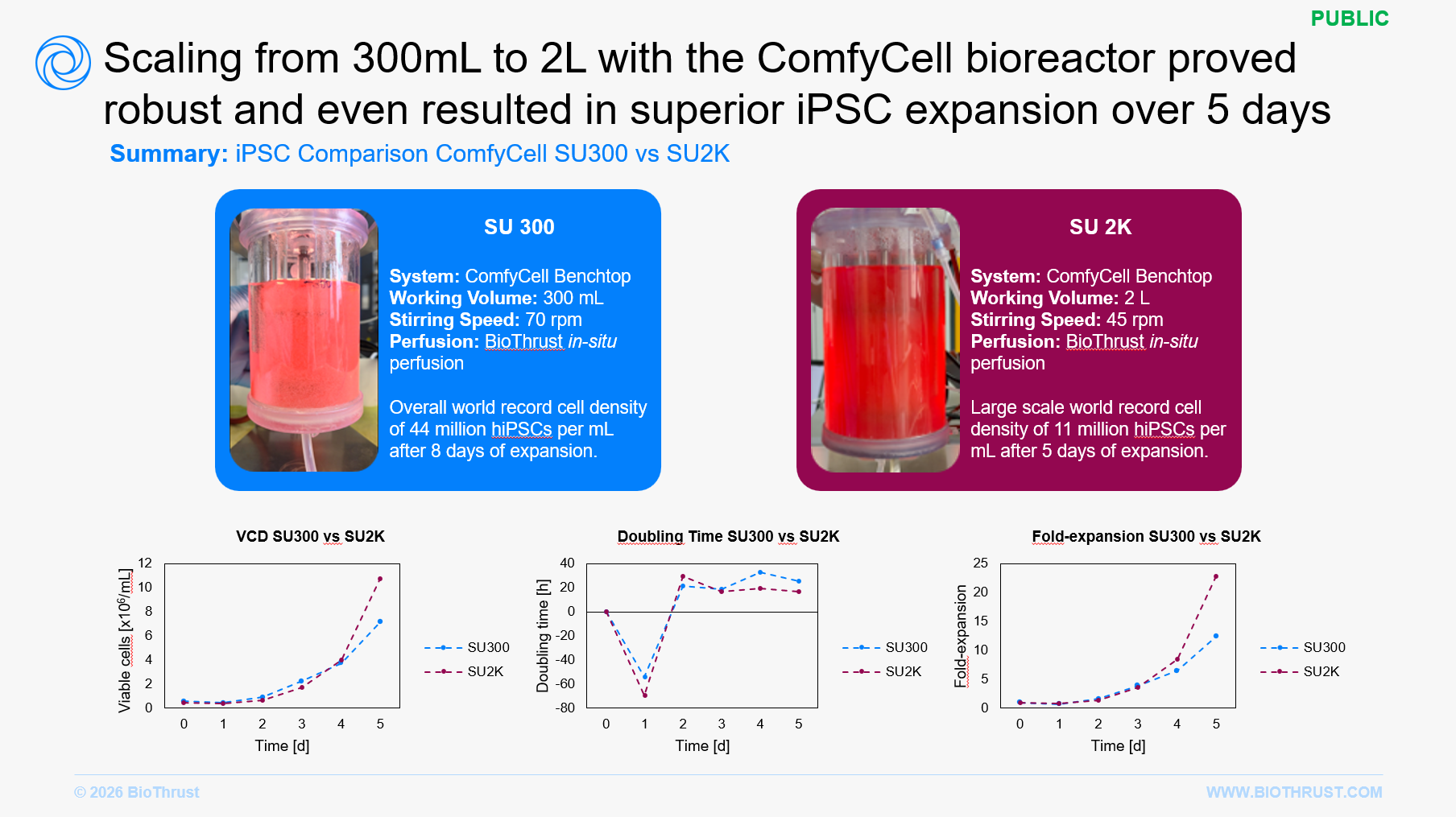
The culture reached approximately 10.8×10⁶ viable iPSCs per mL on day 5, with viability remaining around 90% or above. Flow-cytometry analysis showed high expression of TRA-1-60 and Oct3/4, supporting maintenance of pluripotency. The 2 L run also compared favourably with an earlier 300 mL ComfyCell proof of concept. The 2 L culture reached a higher viable-cell density and fold expansion than the 300 mL proof of concept over the same five-day expansion period.
Toward 20–30 million cells/mL
The development goal is reliable expansion at 20–30 million viable iPSCs per mL across relevant process scales. At these densities, cell retention remains the main engineering challenge. Even with a larger in-situ retention surface, the risk of accumulation rises with biomass, spheroid size, perfusion rate, and run duration. BioThrust is currently evaluating retention-surface design, flow distribution, operating windows, and backflushing strategies to reduce accumulation and sustain perfusion capacity at higher density. The ComfyCell platform combines high oxygen-transfer capacity with integrated in-situ perfusion in a single-use system. This creates a practical foundation for high-density iPSC spheroid culture with fewer external components and a process architecture designed for scale-up.
The data shown represent an early proof of concept. BioThrust is continuing development work to optimise retention performance, anti-fouling strategies, and long-duration perfusion operation at higher cell densities.
Have questions or need finding the right solution?
Our team is here to help you achieve your research goals.

Related Articles

.png)
